Your Trusted 24 Hours Service Provider!

-
 Call Us+86-158-0331-9351
-

-
 AddressHandan City, Hebei , China


Selecting a reliable partner among various industrial hose companies often comes down to more than just a product catalog; it is about matching material science with specific operational stresses. In sectors like mining, chemical processing, and heavy manufacturing, a single hose failure can lead to catastrophic downtime or environmental hazards.
The current market is shifting toward highly specialized polymer composites and reinforced structures that can withstand extreme temperature fluctuations and aggressive chemical media. As regulatory standards like MSHA and ISO9001:2015 become more stringent, the gap between generic rubber tubing and engineered industrial conduits has widened significantly.
To navigate this landscape, procurement managers must look beyond the surface and evaluate the underlying reinforcement technology, certification compliance, and the manufacturer's ability to maintain consistent quality across high-volume shipments.


The transition from simple rubber pipes to complex multi-layered conduits reflects the increasing demands of modern industry. Early industrial hoses relied primarily on natural rubber, which offered flexibility but failed under high thermal stress or when exposed to petroleum-based lubricants.
Today, the focus has shifted toward synthetic elastomers and thermoplastic polymers like Polyamide (PA). This shift allows for tighter tolerances and higher burst pressures, enabling the creation of specialized products like the R8N series, which integrates high-tensile synthetic yarn to maintain structural integrity under fluctuating loads.
Effective hose design is a balance between the inner tube's chemical compatibility and the outer cover's environmental resistance. For instance, using PA (polyamide) for the construction tube ensures that the hose can handle mineral and biological oils without degrading, while a high-flexibility nylon or thermoplastic cover protects against abrasion and external contaminants.
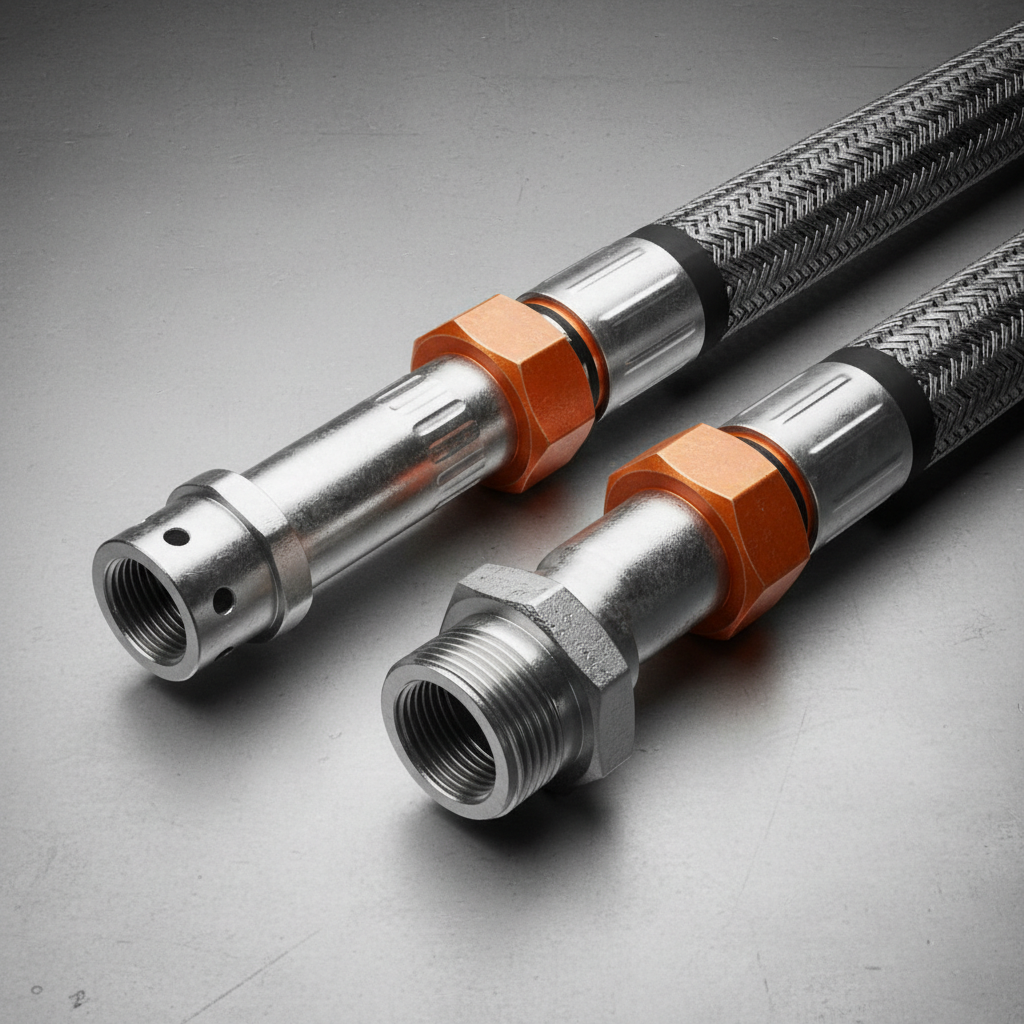
Reinforcement is the core of pressure containment. The use of two high-tensile synthetic yarn braids, as seen in professional-grade industrial conduits, provides a critical safety margin. This braided architecture distributes longitudinal and radial stress evenly, preventing the "ballooning" effect common in lower-quality hoses during pressure spikes.
Temperature range is another decisive technical factor. Engineering a hose to operate from -40℃ to +100℃ requires a precise blend of polymers that remain pliable in arctic conditions while resisting thermal softening in high-heat industrial environments.
In the global market, certifications serve as the primary proxy for quality and safety. When evaluating industrial hose companies, the presence of MSHA, ISO9001:2015, GOST, and SGS approvals indicates that the manufacturer adheres to standardized testing protocols for burst pressure and material purity.
The critical delta between a standard hose and a certified industrial conduit is the "Bursting Pressure" ratio. A high-quality hose must maintain a significant safety factor—often 4:1—between its working pressure and its ultimate burst point to ensure operational safety.
This rigorous validation process ensures that components used in high-risk areas, such as mining or chemical transport, do not fail prematurely. Compliance with these standards means the product has undergone stress testing for bend radius, thermal fatigue, and chemical permeability, reducing the risk of unplanned outages.
Different industrial applications require a specific balance of flexibility, pressure capacity, and weight. By analyzing the relative importance of these factors, companies can better determine which hose specification fits their specific machinery. For example, a hose with a smaller inside diameter often supports significantly higher working pressures due to the relative thickness of the reinforcement layer.
The following index illustrates how different performance priorities shift based on the hose's intended use, from lightweight flexibility to maximum pressure containment.
In a typical industrial setting, such as a hydraulic power unit (HPU), the primary risk is thermal degradation coupled with mechanical vibration. When a manufacturer evaluates their system, they must consider the "Bend Radius." A hose that is forced into a turn tighter than its engineered limit will experience localized stress concentrations, leading to premature reinforcement failure and eventual rupture.
For those operating in mining or biological oil transport, the choice of PA (polyamide) inner tubes is essential. These materials prevent the chemical leaching that occurs with standard rubber, ensuring that the fluid purity remains intact while the exterior nylon cover resists the abrasive nature of mineral dust and debris.
The direction of the industry is moving toward "intelligent" hose assemblies and the integration of sustainable, recyclable polymers without sacrificing pressure ratings. We are seeing a trend where the focus is shifting from simple replacement cycles to predictive maintenance based on the known degradation curves of specific materials.
Furthermore, the integration of German manufacturing technology into production lines has allowed for higher precision in the braiding process. This reduces the variance in bursting pressure across different batches, providing engineers with more predictable data when designing safety systems.
The challenge remains in balancing the extreme durability required for high-pressure hydraulic systems with the need for lower weights to improve the energy efficiency of mobile industrial equipment.
When vetting industrial hose companies, procurement teams should move away from "lowest cost" and toward "lowest total cost of ownership." This involves analyzing the working pressure vs. bursting pressure ratio and the material's compatibility with the specific medium being transported.
A robust decision framework requires a side-by-side comparison of technical specifications. For example, comparing a 1/4" ID hose to a 1" ID hose reveals a dramatic difference in working pressure capabilities—often dropping from 345 bar to 100 bar as the diameter increases, due to the physics of wall tension.
The following table provides a conceptual framework for selecting hose specifications based on common industrial requirements.
| Requirement | Material Priority | Reinforcement | Key Metric |
|---|---|---|---|
| High Pressure / Low Flex | Steel Wire Spiral | Multi-layer Steel | Bursting Pressure |
| Medium Pressure / High Flex | Polyamide (PA) | Synthetic Yarn | Bend Radius |
| Chemical Resistance | PTFE / Thermoplastic | Stainless Steel Braid | Permeability Rate |
| Food/Biological Grade | FDA-Approved Rubber | Textile Braid | Material Purity |
| Extreme Temperature | Specialty Elastomer | High-tensile Yarn | Thermal Range |
| Mining/Abrasive Environment | Nylon/Thermoplastic | Synthetic Yarn | Cover Abrasion Resistance |
A high-quality industrial hose is defined by the synergy of its three layers: a chemically compatible inner tube, a high-tensile reinforcement layer (such as synthetic yarn or steel wire), and a durable outer cover. Beyond materials, quality is validated by the ratio between working pressure and bursting pressure, as well as adherence to international certifications like ISO9001 and MSHA, which ensure consistent performance under stress.
The minimum bend radius is the smallest radius a hose can be bent without compromising its structural integrity or restricting flow. This is typically determined by the hose diameter and the type of reinforcement. If a hose is bent beyond its specified limit, the reinforcement layers can separate or fatigue, leading to a burst. Always refer to the technical data sheet (e.g., the R8N series specifications) to ensure the installation allows for the prescribed radius.
Polyamide (PA) is highly resistant to mineral and biological oils, as well as water-glycol based fluids. Unlike standard rubber, which can swell or soften when exposed to certain hydrocarbons, PA maintains its mechanical properties and prevents fluid contamination. This makes it an ideal choice for hydraulic systems in mining and heavy machinery where fluid purity and long-term durability are critical.
Working pressure is the maximum pressure at which a hose is designed to operate continuously under normal conditions. Bursting pressure is the absolute pressure point at which the hose structurally fails and ruptures. Professional industrial hoses maintain a safety factor (typically 4:1), meaning the bursting pressure is four times the working pressure, providing a critical buffer against unexpected pressure spikes.
MSHA (Mine Safety and Health Administration) certification ensures that the hose meets specific safety requirements for use in underground and surface mining. This usually includes fire resistance and extreme abrasion durability. For procurement managers, choosing MSHA-accepted products reduces legal liability and ensures that the equipment can withstand the harsh conditions of a mine without posing a safety risk to personnel.
No. Using the wrong hose material for a specific fluid can lead to rapid degradation, leaks, or catastrophic failure. For example, a hose designed for water may dissolve when exposed to aggressive chemicals, while a food-grade hose may not withstand high-pressure hydraulic oil. Always match the inner tube material (e.g., PTFE for chemicals, PA for oils, or specialized rubber for steam) to the chemical properties of the medium.
The complexity of modern fluid conveyance demands a move away from commoditized purchasing toward a technical partnership. By prioritizing material science, reinforcement logic, and verified certifications, companies can significantly reduce the risk of operational failure and extend the lifecycle of their machinery.
Ultimately, the value provided by experienced industrial hose companies lies in their ability to match the precise physical requirements of an application with the correct chemical and mechanical properties of the hose, ensuring safety and efficiency in the most demanding environments.