

THE BUYER'S GUIDE / SELECTION
Choosing a 300 PSI Air Hose for Tank Truck Use: Medium, Dimensions, and Operating Conditions
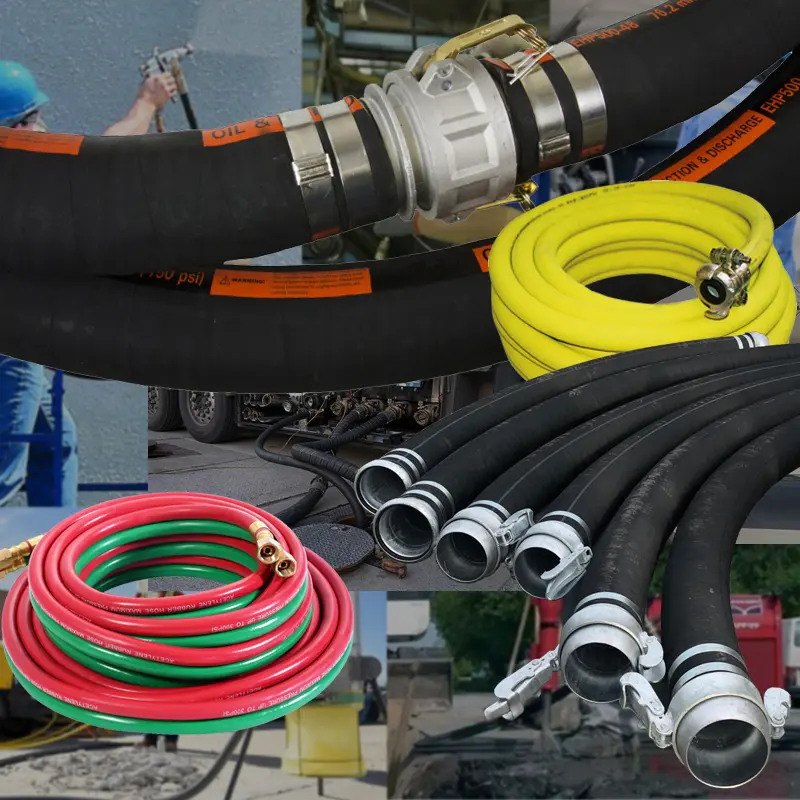
Selecting the right 300 psi air hose for tank truck and industrial service requires matching the transfer medium, bore size, reinforcement layers, and temperature range to the actual operating conditions. This guide walks buyers through the key criteria — tube compound compatibility, working and burst pressure ratings, dimensional range, cover construction, and environmental resistance — and maps those criteria to two confirmed rubber hoses from HEBEI SINOPULSE TECH GROUP CO.,LTD. that carry a 300 psi (20 bar) working pressure rating.

Transfer medium compatibility: NBR tube for petroleum and aromatic hydrocarbons (up to 50% aromatic content); NR/SBR tube for dry bulk and abrasive slurries
Working and burst pressure rating: 20 bar / 300 psi working pressure with 60 bar / 900 psi burst pressure (3:1 safety factor) required for tank truck and industrial transfer service
Bore and dimensional range: match inside diameter to pump/manifold connections; confirmed range 1" to 10" across both product lines
Reinforcement construction: high-tensile textile cord with helix wire for suction capability; ply count scales with bore diameter
Cover construction and environmental resistance: weather/ozone-resistant cover for petroleum environments; abrasion-resistant cover for material delivery
Anti-static construction: copper helix wire mandatory for flammable fuel transfer
Operating temperature range: confirmed −30 °C to +80 °C for NBR-tube petroleum hose
Why Rated Pressure Matters When Choosing a 300 PSI Air Hose
A 300 psi air hose rating means the hose is engineered to sustain 300 pounds per square inch (20 bar) of working pressure continuously during service. In tank truck, petroleum transfer, and material delivery applications this figure sets the floor for safety, not the ceiling — the actual burst pressure of correctly selected hoses can be three times the working pressure (a 3:1 safety ratio), giving operators a meaningful margin before catastrophic failure. Working pressure is, therefore, the first specification a buyer must confirm before any other selection criterion.
Key Selection Criteria
1. Transfer Medium Compatibility
The tube compound must be chemically compatible with whatever fluid or material the hose will carry. Getting this wrong causes internal swelling, softening, or cracking, which shortens service life dramatically and creates safety hazards.
- Petroleum-based products (fuels, diesel, gasoline, lubricants, ethanol blends up to 50% aromatic content): Require a nitrile rubber (NBR) tube. NBR resists oil and hydrocarbon permeation far better than natural or styrene-butadiene rubber.
- Dry bulk materials, slurries, or abrasive media: Require a natural rubber (NR) or SBR compound designed for abrasion resistance rather than oil resistance.
Using an oil-resistant hose on abrasive dry material, or vice versa, degrades performance prematurely. Always confirm the medium before specifying a tube compound.
2. Working Pressure and Burst Pressure
For hoses rated at 300 psi working pressure:
- Confirmed working pressure: 20 bar / 300 psi
- Confirmed burst pressure: 60 bar / 900 psi (3:1 safety factor)
Operators should never exceed the rated working pressure in service. System pressure spikes, water hammer effects, and dynamic loading can briefly push pressures above steady-state readings; the 3:1 safety factor accounts for those transients, but additional de-rating may be appropriate in high-cycle or high-vibration environments.
3. Bore (Inside Diameter) and Dimensional Range
Flow rate and connection interface both depend on bore size. Matching the hose bore to the pump outlet, tank connection, or manifold fitting prevents throttling losses and ensures that standard couplings seat correctly.
Different 300 psi rubber hose products cover different bore ranges:
| Application Focus | Available ID Range |
|---|---|
| Tank truck / petroleum transfer | 1-1/2" (38.2 mm) to 8" (203.0 mm) |
| Material delivery (dry bulk / slurry) | 1" (25.4 mm) to 10" (254.0 mm) |
For tank truck petroleum service, the available part numbers span from OT300-24 (1-1/2") through OT300-128 (8"). For material delivery service, the range extends further — from MD300-16 (1") to MD300-160 (10") — because bulk material handling frequently requires larger cross-sections to maintain adequate flow velocity without clogging.
4. Reinforcement Layers and Helix Wire
Reinforcement determines both pressure rating and structural rigidity:
- Textile cord reinforcement with helix wire is standard for tank truck oil hoses. The helix wire supports the hose wall under vacuum (suction service) and prevents kinking or collapse when bending around fittings.
- Single or double steel wire options are available for material delivery hoses to suit different suction and discharge demands.
- Ply count increases with bore: smaller bores (1"–2-1/2") use 2–4 plies; larger bores (3" and above) use 6–8 plies to maintain the 300 psi working pressure across a wider cross-section.
5. Cover Construction and Environmental Resistance
The outer cover must withstand the installation environment, not just the fluid inside:
- Smooth or corrugated surface options affect flexibility and handling; corrugated covers flex more freely in tight routings.
- Textile surface variants offer a different tactile profile for applications where grip or marking is needed.
- Covers are compounded for weather and ozone resistance on petroleum hoses, and for abrasion resistance on material delivery hoses.
- Anti-static construction (copper helix wire) is built into tank truck oil hoses to dissipate static charge generated during fuel transfer — a critical safety feature when handling flammable liquids.
6. Temperature Range
Confirmed operating temperature for the petroleum transfer (NBR tube) construction: −30 °C (−22 °F) to +80 °C (+176 °F).
Operators should verify that ambient and fluid temperatures remain within this range throughout the service cycle. Exposure to temperatures above the rated maximum softens rubber compounds and accelerates degradation; exposure below the minimum rating causes hardening and cracking, especially at bends.
Which 300 PSI Rubber Hose Fits Your Application?
HEBEI SINOPULSE TECH GROUP CO.,LTD. manufactures two distinct 300 psi rubber hose product lines that address different buyer needs:
Tank Truck Rubber Hose 300 PSI
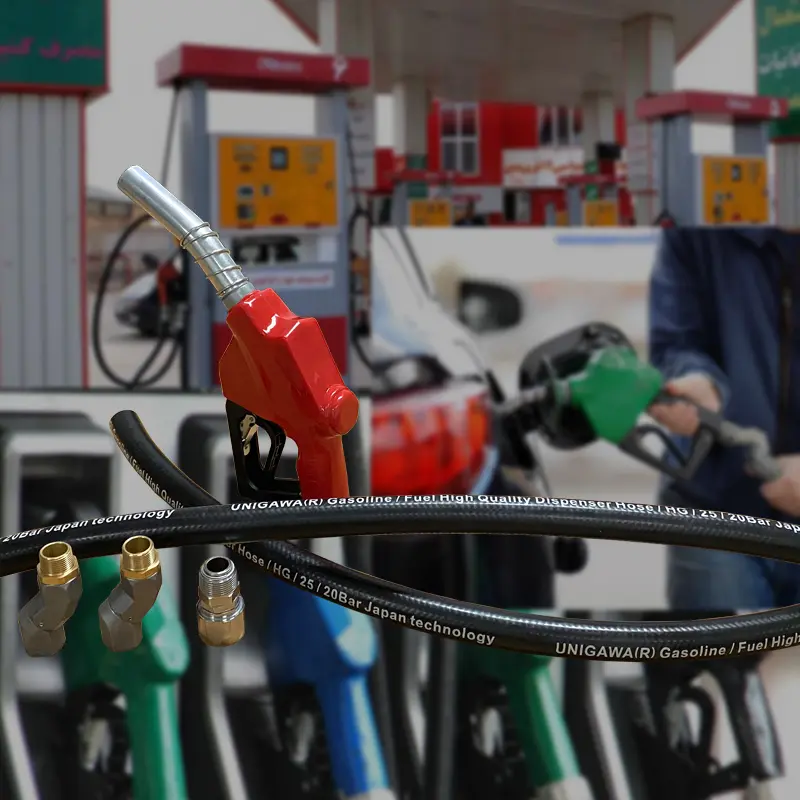
Designed specifically for suction and discharge of petroleum-based products — diesel, gasoline, lubricants, fuel, and ethanol blends — in tank truck, rail tanker, and in-plant oilfield loading operations.
Construction highlights:
- Tube: NBR synthetic rubber (black) — oil and aromatic hydrocarbon resistant
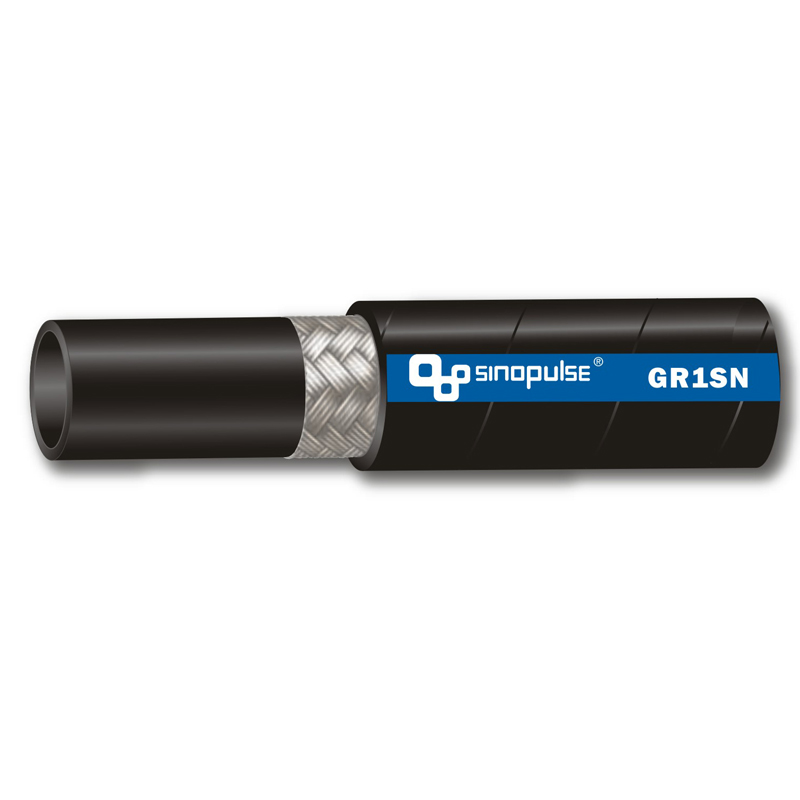
- Reinforcement: High-tensile textile cord with helix wire
- Cover: Black, yellow, red, or green; smooth (wrapped) or corrugated; weather- and ozone-resistant synthetic rubber
- Anti-static: Copper wire helix integrated for static dissipation
- Working pressure: 20 bar / 300 psi; Burst pressure: 60 bar / 900 psi
- Temperature: −30 °C to +80 °C
- Bore range: 1-1/2" to 8" (6 standard sizes)
- Ply count: 4 plies up to 4"; 6 plies for 6" and 8"
Best suited for: Flammable fuel and petroleum transfer requiring suction capability, anti-static protection, and oil-resistant tube.
Material Delivery Rubber Hose 300 PSI
Engineered for dry bulk materials and slurry transfer where abrasion resistance matters more than oil resistance.
Construction highlights:
- Tube: NR & SBR synthetic rubber (black) — abrasion-resistant
- Reinforcement: High-tensile textile cord or textile cord with helix steel wire (single or double wire options)
- Cover: Black, smooth or corrugated, abrasion-resistant NR synthetic rubber
- Tube wall thickness customizable to application requirements
- Working pressure: 20 bar / 300 psi; Burst pressure: 60 bar / 900 psi
- Bore range: 1" to 10" (12 standard sizes)
- Ply count: 2 plies at 1"; up to 8 plies at 8"; 6 plies at 10"
Best suited for: Dry material, aggregate, and slurry discharge where cover and tube abrasion resistance are the dominant wear mechanism.
Decision Summary: Matching Criteria to Application
| Criterion | Tank Truck 300 PSI | Material Delivery 300 PSI |
|---|---|---|
| Primary medium | Petroleum / fuel | Dry bulk / slurry |
| Tube compound | NBR (oil-resistant) | NR & SBR (abrasion-resistant) |
| Anti-static feature | Yes (copper wire) | Not specified |
| ID range | 1-1/2" – 8" | 1" – 10" |
| Cover type | Weather/ozone resistant | Abrasion resistant |
| Temperature range (confirmed) | −30 °C to +80 °C | |
| Safety factor | 3:1 | 3:1 |
Buyers whose system handles flammable petroleum products should prioritize the NBR tube and anti-static helix construction of the tank truck line. Buyers handling abrasive dry media should prioritize the harder, more wear-resistant NR/SBR tube and cover of the material delivery line.
What This Guide Does Not Cover
For specific pricing, custom bore dimensions, fitting type, or certification documentation, contact HEBEI SINOPULSE TECH GROUP CO.,LTD. directly.
Frequently Asked Questions
Can I use a tank truck petroleum hose as a general 300 psi air hose? The hose is rated for petroleum-based fluid transfer, not for compressed air service. Using a petroleum-medium hose as a compressed air line may be inappropriate or unsafe. Verify the intended medium with the manufacturer before substituting applications.
Are both hoses available in suction and discharge configurations? Both product lines include helix wire reinforcement options that support vacuum or suction service, but the helix wire specification differs between the lines. Confirm the suction rating for your exact bore and configuration with HEBEI SINOPULSE TECH GROUP CO.,LTD. before ordering.
Can the tube wall thickness be customized? For the material delivery hose, the source confirms that tube wall thickness can be customized according to customer requirements. Similar flexibility for the tank truck line should be confirmed directly with the manufacturer.
THE PEOPLE

About the author
THE COMPANY
HEBEI SINOPULSE TECH GROUP CO.,LTD.
Sinopulse is a renowned company that has been a leading industrial pipe, various hose fittings, and hydraulic hose manufacturer since its establishment in 2011. Founded by three brothers Cao, the company has grown from strength to strength, establishing itself as a key player in the industry.…
About Us ↗Visit company website ↗YOUR NEXT STEP
Bring your brief. Start a useful conversation.
Use case, specification, quantity and delivery window: make the next conversation specific.

Product Application